

Imagine a global network of thousands of computers, running
around the clock, consuming electricity at the rate of a
mid-sized country, all competing to solve a puzzle that has no
practical purpose — except one: keeping Bitcoin honest.
That is Bitcoin mining. Not a metaphor. Not marketing language.
That is the literal description of the process that has secured
every single transaction on the Bitcoin network since block
zero was produced by Satoshi Nakamoto on 3 January 2009.
To most people, Bitcoin is a price on a screen. To miners, it
is the output of an enormous, competitive, energy-intensive
infrastructure — one that substitutes mathematical proof for
the trust we normally place in banks and governments.
This guide explains exactly how that infrastructure works,
why it exists, what it costs, and whether it makes economic
sense to participate in it.
Before understanding mining, it helps to understand the problem it solves. When you pay for something with a bank card, your bank acts as a trusted referee: it checks your balance, deducts the amount, and ensures the same money cannot be spent twice. That single point of trust is what makes the system work.
Bitcoin has no bank. No referee. Anyone in the world can broadcast a transaction to the network — but without a central authority to validate it, how does everyone agree on which transactions are legitimate and which are fraudulent?
More specifically: what stops someone from broadcasting the same Bitcoin to two different recipients simultaneously and disappearing with both? This is called the double-spend problem, and it is the fundamental challenge that every digital currency must solve. Source: Bitcoin.org — Bitcoin Whitepaper
Satoshi Nakamoto's answer was Proof of Work: a system where the right to validate transactions must be earned through real computational effort — making fraud not just difficult but economically irrational. Bitcoin mining is the implementation of that answer.
Bitcoin mining is the process by which transactions are validated, grouped into blocks, and permanently added to the Bitcoin blockchain — while simultaneously releasing new Bitcoin into circulation as a reward for the miners who perform this work.
The word "mining" is an analogy borrowed from precious metals. Just as gold miners expend physical effort to extract a scarce resource from the earth, Bitcoin miners expend computational effort to "extract" new Bitcoin from the protocol's fixed supply. The total supply of Bitcoin is capped at 21 million coins — a hard limit encoded in the protocol that no authority can change. Source: Bitcoin.org
As of 2024, approximately 19.7 million Bitcoin have been mined. The remaining supply trickles out through the mining process, with the last coin projected to be mined around the year 2140. Source: CoinMarketCap
The mechanics of Bitcoin mining involve cryptography, competition, and economic incentives — all operating simultaneously. Here is what actually happens.
Every Bitcoin transaction broadcast to the network sits in a waiting area called the mempool (memory pool) until a miner picks it up. Miners select transactions from the mempool to fill a new block — typically prioritising those with the highest fees attached, since fees go directly to the miner. Source: Ethereum.org, Bitcoin.org
Once a miner bundles transactions into a candidate block, they must solve a cryptographic puzzle to earn the right to add it to the chain. That puzzle involves the SHA-256 hash function — an algorithm that takes any input and produces a unique 64-character hexadecimal output called a hash.
The network requires this hash to begin with a specific number of zeros — a target set by the protocol. Producing a hash that meets the target is not mathematically solvable; it can only be found by brute force. Miners repeatedly change a variable in the block called the nonce (number used once) and re-hash the block millions of times per second until one produces a valid result.
The more zeros the target requires at the start of the hash, the harder the puzzle — because a smaller portion of all possible outputs will qualify. This is how the protocol controls difficulty. Source: Investopedia — Target Hash
The entire global network of miners competes simultaneously on the same puzzle. The first miner to find a valid hash broadcasts their solution to the network. Every other node can verify the solution in milliseconds — confirming it with a single hash calculation rather than billions.
The winning miner's block is added to the blockchain, the transactions inside are confirmed, and new Bitcoin is issued to the winner as a block reward. The competition then resets immediately for the next block.
Bitcoin is designed to produce one new block approximately every 10 minutes. As more miners join the network and total hashing power increases, blocks would be found too quickly — so the protocol automatically increases the difficulty of the puzzle every 2,016 blocks (roughly every two weeks) to bring the block time back to target. Source: Bitcoin.org — Mining
Conversely, if miners leave the network, difficulty decreases. This self-correcting mechanism is one of Bitcoin's most elegant design features — a living system that adapts to the amount of computational power participating in it at any given moment.
Every 210,000 blocks — approximately every four years — the Bitcoin protocol automatically cuts the block reward in half. This event is called the Bitcoin Halving, and it is the mechanism Satoshi used to enforce Bitcoin's disinflationary monetary policy. Source: Bitcoin.org — Controlled Supply
| Period | Block Reward | Approximate USD Value per Block* |
|---|---|---|
| 2009 – 2012 | 50 BTC | Near zero at inception |
| 2012 – 2016 | 25 BTC | ~$25,000 (at $1,000/BTC) |
| 2016 – 2020 | 12.5 BTC | ~$87,500 (at $7,000/BTC) |
| 2020 – 2024 | 6.25 BTC | ~$187,500 (at $30,000/BTC) |
| 2024 – 2028 | 3.125 BTC | ~$187,500+ (at $60,000+/BTC) |
*Approximate values for illustration only. Actual USD value varies with Bitcoin price.
The pattern reveals something important: although the BTC reward shrinks with every halving, the rising price of Bitcoin has historically compensated miners in fiat terms. Whether this dynamic continues through future halvings remains one of the most debated questions in Bitcoin economics.
When the last Bitcoin is mined around 2140, block rewards will reach zero. At that point, transaction fees will become the sole source of miner income — a design that assumes Bitcoin's ongoing utility will sustain sufficient fee revenue to keep miners economically motivated to secure the network. Source: Bitcoin.org — Halving
Mining Bitcoin in 2024 is not a hobby project. The competitive landscape has matured to the point where profitability requires serious capital investment, access to cheap electricity, and sophisticated operational management. Here is what serious participants need.
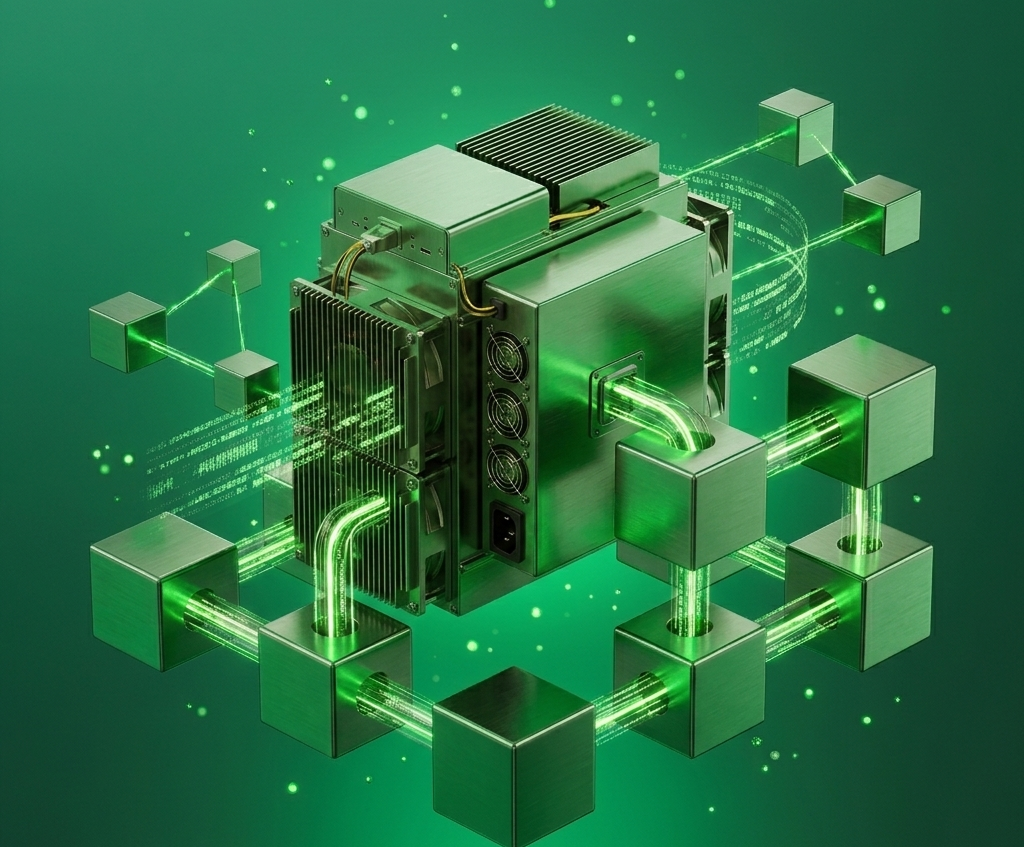
The only practical way to mine Bitcoin competitively today is with an Application-Specific Integrated Circuit (ASIC) miner — a chip designed exclusively to run the SHA-256 hash function as fast and efficiently as possible.
Leading ASIC models from manufacturers like Bitmain (Antminer series) and MicroBT (Whatsminer series) can perform trillions of hash calculations per second — measured in terahashes per second (TH/s). A single high-end unit as of 2024 can cost $2,000–$10,000 before shipping and installation. Source: Bitmain, MicroBT
GPU mining, which was viable in Bitcoin's early years, is no longer competitive for Bitcoin specifically. GPUs are still used for mining other cryptocurrencies that use different algorithms.
ASIC miners consume between 3,000 and 6,000 watts of power each. For a miner running dozens or hundreds of units, energy cost is by far the largest operational expense — often determining whether mining is profitable at all.
Miners with access to electricity at below $0.05 per kWh — often sourced from hydroelectric, geothermal, or surplus renewable energy — can operate profitably at most Bitcoin price levels. Miners paying $0.10–$0.15/kWh find profitability marginal, and anything above that is generally unviable without a significant BTC price premium. Source: Cambridge Centre for Alternative Finance — CBECI
Mining software connects your hardware to the Bitcoin network or to a mining pool. Open-source options like CGMiner and BFGMiner are widely used and support most major ASIC hardware. Beyond software, large-scale operations require stable high-bandwidth internet, physical facilities with industrial cooling, and power distribution infrastructure.
Even with top-tier hardware, an individual miner competing against industrial-scale operations faces the same challenge as a single lottery ticket competing against an institution buying millions: the odds of winning any given block are vanishingly small.
Mining pools solve this by aggregating the hashing power of thousands of participants into a single entity that competes collectively. When the pool wins a block reward, it is divided among all participants in proportion to the hashing power each contributed — measured in shares.
The pool operator takes a small percentage fee (typically 1–3%) for coordination services. In return, pool members receive smaller but far more regular and predictable income compared to solo mining. Source: Slush Pool, F2Pool
| Mining Pool | Approx. Network Share | Notable Feature |
|---|---|---|
| Foundry USA | ~28% | Largest pool globally, US-focused |
| AntPool | ~17% | Operated by Bitmain |
| F2Pool | ~14% | One of the oldest active pools |
| ViaBTC | ~10% | Supports multiple cryptocurrencies |
| Slush Pool (Braiins) | ~3% | World's first Bitcoin mining pool (2010) |
Source: BTC.com Pool Statistics, 2024
A key concern with large mining pools is the concentration of hashing power. If any single pool approaches 51% of total network hash rate, it theoretically gains the ability to manipulate the blockchain — a scenario the community monitors closely and that individual miners can mitigate by choosing smaller, more distributed pools.
Bitcoin mining has produced extraordinary wealth for early participants and well-capitalised operations. It has also destroyed capital for countless others who entered without fully accounting for what follows.
A single competitive ASIC miner costs $2,000–$10,000. A meaningful mining operation requires dozens to hundreds of units. Add facility costs, cooling systems, electrical infrastructure, and pool fees, and the capital requirement for a viable mining business is measured in six to seven figures — before a single satoshi is earned.
A miner's revenue is denominated in Bitcoin but most costs are denominated in fiat. When the Bitcoin price falls sharply — as it has in every bear market — mining revenue collapses in fiat terms while electricity and hardware costs remain constant. Operations that were highly profitable at $60,000 BTC can become loss-making below $20,000. Source: CoinMarketCap
The Bitcoin network consumes approximately 120–150 terawatt-hours of electricity annually — comparable to the annual consumption of countries like Norway or Ukraine. Source: Cambridge Centre for Alternative Finance (CBECI)
Proponents argue that an increasing share of mining is powered by renewable and stranded energy sources, and that securing a $1 trillion+ asset network is a legitimate use of energy resources. Critics argue the absolute consumption figure remains unsustainably high regardless of energy source. Both perspectives hold legitimate data points. The debate is ongoing.
Mining legality varies significantly by jurisdiction and can change without warning. China — once home to over 65% of global Bitcoin mining — banned all crypto mining in 2021, forcing a mass migration of operations to the US, Kazakhstan, Russia, and Canada. Several other countries have imposed restrictions, energy taxes on mining, or outright bans. Source: Reuters, Cambridge CBECI
Tax treatment of mining income also varies widely: in many jurisdictions, mined Bitcoin is treated as ordinary income at the moment of receipt, and subsequent price gains or losses are subject to capital gains tax. Consulting a tax professional before beginning any mining operation is essential.
This is the question every prospective miner eventually asks, and the honest answer is: it depends on factors most individuals cannot fully control.
- Electricity cost below $0.05/kWh — mining can be consistently profitable at most Bitcoin price levels above $30,000–$40,000.
- Electricity cost $0.07–$0.10/kWh — profitability becomes highly dependent on Bitcoin price being well above current levels and staying there.
- Electricity cost above $0.12/kWh — mining is generally loss-making at most realistic Bitcoin price scenarios. Industrial-scale pools are the only participants who can absorb this cost structure.
For most retail participants, purchasing Bitcoin directly is a more capital-efficient way to gain exposure than mining. Mining is an industrial business that happens to produce Bitcoin — not primarily an investment strategy, although the two can overlap at scale.
Cloud mining services — where you rent hashing power from a data centre — theoretically offer access without hardware investment, but this space has a well-documented history of fraud and unverifiable claims. Extreme due diligence is required before committing capital to any cloud mining platform.
- Bitcoin mining solves the double-spend problem — allowing a decentralised network to agree on the validity of transactions without a central authority.
- Miners compete to solve a SHA-256 cryptographic puzzle. The winner adds the next block and earns the block reward plus all transaction fees in that block.
- The block reward halves approximately every four years. After the 2024 halving it stands at 3.125 BTC per block. The last Bitcoin will be mined around 2140.
- Bitcoin's difficulty adjustment ensures a block is produced roughly every 10 minutes regardless of how much or how little hashing power is on the network.
- Mining pools allow individuals to combine hashing power and earn proportional shares of block rewards — converting an unpredictable lottery into a more consistent income stream.
- Profitability depends primarily on electricity cost, Bitcoin price, hardware efficiency, and regulatory environment — factors that make large-scale industrial operations better positioned than individual miners.
Strip away the economics and Bitcoin mining is fundamentally a trust mechanism. Every terawatt-hour of electricity consumed by the network represents a concrete, physical cost that an attacker would need to match — and exceed — to rewrite Bitcoin's history. That cost is Bitcoin's security budget.
The more energy the network consumes, the more expensive an attack becomes, and the more trustworthy the ledger is without any single party vouching for it. In this sense, mining is not waste — it is the price of a particular form of trust: one rooted in mathematics and thermodynamics rather than legal authority or institutional reputation.
Whether that form of trust is worth its energy cost is a question society is still working through. But understanding how mining works is the prerequisite for engaging with that question honestly.